| ||
|
Friday, September 26, 2014
Rural British Columbians need more action, less talk - BC Conservative Party leader Dan Brooks
This came into my email box


Monday, April 7, 2014
Wednesday, January 8, 2014
Monday, January 6, 2014
Saturday, September 28, 2013
Hunting, one of the biggest divides between rural and urban BC
In urban BC, places like Metro Vancouver, Victoria, Kelowna and Prince George most people have no direct connection with anyone that hunts. Once you get to places like Lillooet, Fort St James, Port McNeil and many other small towns it is almost impossible to live your life and not know someone that hunts. Most people in urban BC have never tasted and wild meats like moose, cougar, bear and waterfowl while in rural BC the poorer people all tend to have wild meat as part of the annual diet.
This divide on hunting is one of the biggest divisions between urban and rural. In rural BC a rifle is still a hunting tool that many houses will have. Bears in your backyard happen and you need to figure out how to deal with them and hunting is a legitimate option.
At the heart the division is one based on how connected people are to the land and the world around them. Many urban people have an unrealistic view of the wilderness because they have such limited connection to it. Urban residents have developed a anthropomorphic view of wild animals and goes from the silly of feeding deer to the seriously dangerous view of bears as something warm and cuddly.
I have an very healthy respect for grizzly bears. I have met a few people in my life who had an encounter with one and lived to tell the story. I have see a few and been glad they have been far enough away to not be a threat to me such as one time at Leon Creek when I saw one 200 meters away and on the other side of the creek.
Black bears are a much bigger problem because they are happy enough to come into town. Having seen them up close, less then five meters away, they are not something to be trifled with.
I considered buying a rifle when I lived in Lillooet to go hunting because it would be a cost effective and healthy way to feed my family. I could have gone out after work and hunted for an hour or two. To do something similar here on the island would take a weekend or more. Ideally I would want to go to the interior to hunt there and that then really means four to five days at a minimum. My hunting would not be to have a head stuffed and mounted, it would be about getting meat in the freezer.
Urban residents tend to rather divorced from where their meat comes from and have trouble looking at a moose or deer and seeing anything other than a majestic animal. Few of them look at a deer and think that it is a great way to get away for factory farmed meat even when they are not vegetarians.
For the rural resident hunting is part of the world around them that they are part of. The urban resident sees rural BC and the wilderness as a mythic preserve to he held in reverence and hunting has no place in it.
This divide on hunting is one of the biggest divisions between urban and rural. In rural BC a rifle is still a hunting tool that many houses will have. Bears in your backyard happen and you need to figure out how to deal with them and hunting is a legitimate option.
At the heart the division is one based on how connected people are to the land and the world around them. Many urban people have an unrealistic view of the wilderness because they have such limited connection to it. Urban residents have developed a anthropomorphic view of wild animals and goes from the silly of feeding deer to the seriously dangerous view of bears as something warm and cuddly.
I have an very healthy respect for grizzly bears. I have met a few people in my life who had an encounter with one and lived to tell the story. I have see a few and been glad they have been far enough away to not be a threat to me such as one time at Leon Creek when I saw one 200 meters away and on the other side of the creek.
Black bears are a much bigger problem because they are happy enough to come into town. Having seen them up close, less then five meters away, they are not something to be trifled with.
I considered buying a rifle when I lived in Lillooet to go hunting because it would be a cost effective and healthy way to feed my family. I could have gone out after work and hunted for an hour or two. To do something similar here on the island would take a weekend or more. Ideally I would want to go to the interior to hunt there and that then really means four to five days at a minimum. My hunting would not be to have a head stuffed and mounted, it would be about getting meat in the freezer.
Urban residents tend to rather divorced from where their meat comes from and have trouble looking at a moose or deer and seeing anything other than a majestic animal. Few of them look at a deer and think that it is a great way to get away for factory farmed meat even when they are not vegetarians.
For the rural resident hunting is part of the world around them that they are part of. The urban resident sees rural BC and the wilderness as a mythic preserve to he held in reverence and hunting has no place in it.
Tuesday, July 16, 2013
Land trusts as a model to protect farm lands
Among the people that are afraid we are losing our farmland, there is a move to use land trusts as a way to ensure that land is kept for agriculture. The best example I know of is Madrona Farm in Victoria. While the idea of using land trusts as a way to protect land for agriculture is innovative, it has some major problems.
100 acres of prime farm land in the Okanagan will set you back $5,000.000 to $6,000,000. The largest land trust in Canada is Ducks Unlimited which focuses wetlands for waterfowl. The largest land trust that could be in the business of buying up agricultural land is the Nature Conservancy of Canada which has an annual income of $70,000,000 or so per year to buy land, most of this is intended for critical wildlife habitat.
The Land Conservancy worked hard to raise the money to purchase Madrona Farm. The amounts involved were not huge, $1,300,000 for the 27 acres - the owners donated $700,000. It took huge amounts of effort to raise all the money needed to buy the land. I am not convinced that there is much chance that a significant sized property could be saved with a land trust in this region.
2) Farmers need security for capital purchases
Farmers need assets to be able to access the capital they need to be able to farm. A farm needs a lot equipment, as an example, buying a tractor is expensive and needs financing. Farms also need buildings for storage. A good fruit and vegetable operation really has to have a cold storage building. Without an asset you can not borrow the money for farming capital projects. Working without the equipment needed dramatically reduces the efficiency of the farm. The land will produce less food while taking much more human effort.
It is not only capital that is needed for machinery, it is also needed for things like fruit trees. Planting an acre of apple trees will cost you between $5,000 and $15,000 depending on type of tree and planting style. It also takes a number of years before fruit trees are in full production. A ten acre high density apple orchard costs about $150,000 to put in and takes three years till properly productive. If you can not borrow against the land fruit trees, grapes and other long term perennial crops are impossible to develop.
3) Farming has cash flow problems
Farming also suffers from huge fluctuations in cash flow over the year. 100% of the income is between the end of June and the end of October - four and half months at best. This means for the majority of the year there is no income but life still goes on. You need an income to live and the farm has expenses all year round.
Farming means having to have a large line of credit to smooth out the cash flow problems which means you need a line of credit the equivalent to a year's income, even a small farm needs $100,000 to $200,000 to be sustainable. To have a decent line of credit you need an asset to pledge that is worth enough and the only thing that could be is the land.
4) Farmers need to be able to be able to make long term decisions about the land
Farmers need the ability to make long term decisions and this means leases with few or no restrictions. Realistically most Land Trusts are going not going to be open to any agriculture but only a specific narrow concept of what is agriculture. A large scale composting facility is not likely going to be ok. Leases with land trusts will be restricted.
The lease has to be long enough that the farmer can plan for decades down the road. Putting in an orchard is a long term investment which only makes sense if you know you can benefit from it. How long will the leases be for? 10 years? 20 years? 99 years?
5) Land Trusts are not as secure as people think
Land trusts can make mistakes and end up short of money. The last couple of years at The Land Conservancy here in Victoria shows what can happen when things begin to go wrong. At the end of the day all land trusts are private entities over which the public and government have no direct control
- Farm land costs a lot of money
- Farmers need some asset as security for capital investments
- Farms have major cash flow problems
- Farmers need the freedom to plan for the long term
- Land trusts are not as safe or secure as people think
100 acres of prime farm land in the Okanagan will set you back $5,000.000 to $6,000,000. The largest land trust in Canada is Ducks Unlimited which focuses wetlands for waterfowl. The largest land trust that could be in the business of buying up agricultural land is the Nature Conservancy of Canada which has an annual income of $70,000,000 or so per year to buy land, most of this is intended for critical wildlife habitat.
The Land Conservancy worked hard to raise the money to purchase Madrona Farm. The amounts involved were not huge, $1,300,000 for the 27 acres - the owners donated $700,000. It took huge amounts of effort to raise all the money needed to buy the land. I am not convinced that there is much chance that a significant sized property could be saved with a land trust in this region.
2) Farmers need security for capital purchases
Farmers need assets to be able to access the capital they need to be able to farm. A farm needs a lot equipment, as an example, buying a tractor is expensive and needs financing. Farms also need buildings for storage. A good fruit and vegetable operation really has to have a cold storage building. Without an asset you can not borrow the money for farming capital projects. Working without the equipment needed dramatically reduces the efficiency of the farm. The land will produce less food while taking much more human effort.
It is not only capital that is needed for machinery, it is also needed for things like fruit trees. Planting an acre of apple trees will cost you between $5,000 and $15,000 depending on type of tree and planting style. It also takes a number of years before fruit trees are in full production. A ten acre high density apple orchard costs about $150,000 to put in and takes three years till properly productive. If you can not borrow against the land fruit trees, grapes and other long term perennial crops are impossible to develop.
3) Farming has cash flow problems
Farming also suffers from huge fluctuations in cash flow over the year. 100% of the income is between the end of June and the end of October - four and half months at best. This means for the majority of the year there is no income but life still goes on. You need an income to live and the farm has expenses all year round.
Farming means having to have a large line of credit to smooth out the cash flow problems which means you need a line of credit the equivalent to a year's income, even a small farm needs $100,000 to $200,000 to be sustainable. To have a decent line of credit you need an asset to pledge that is worth enough and the only thing that could be is the land.
4) Farmers need to be able to be able to make long term decisions about the land
Farmers need the ability to make long term decisions and this means leases with few or no restrictions. Realistically most Land Trusts are going not going to be open to any agriculture but only a specific narrow concept of what is agriculture. A large scale composting facility is not likely going to be ok. Leases with land trusts will be restricted.
The lease has to be long enough that the farmer can plan for decades down the road. Putting in an orchard is a long term investment which only makes sense if you know you can benefit from it. How long will the leases be for? 10 years? 20 years? 99 years?
5) Land Trusts are not as secure as people think
Land trusts can make mistakes and end up short of money. The last couple of years at The Land Conservancy here in Victoria shows what can happen when things begin to go wrong. At the end of the day all land trusts are private entities over which the public and government have no direct control
Thursday, June 6, 2013
May 2013 election in rural BC
I consider the following 16 ridings to be the rural ridings in BC.
- Boundary-Similkameen
- Cariboo North - won by Bob Simpson in 2009 as a New Democrat but he was defeated in 2013 as an independent
- Cariboo-Chilcotin - round three of Donna Barnett (Liberal) versus Charley Wyse (NDP)
- Columbia River-Revelstoke
- Fraser-Nicola - won by Harry Lali NDP in 2009, defeated by Jackie Teggart Liberal in 2013
- Kootenay East - First two person in BC since 1991
- Kootenay West
- Nechako Lakes
- Nelson-Creston
- North Coast
- North Island
- Peace River North - a close race between Pat Pimm Liberal and Arthur Hadland in 2009 turned into a blow out for Pat Pimm in the rematch this year
- Peace River South - best BC Conservative result in BC since 1979
- Shuswap
- Skeena
- Stikine
The split in seats was nine Liber and seven NDP which is the reverse of 2009
Overall party results
Elect Liberal % NDP % Green % BCCP % Others %
2013 101,898 43.72 91,889 39.43 11,953 5.13 12,993 5.57 14,330 6.15
2009 92,741 41.23 100,831 44.82 16,167 7.19 9,558 4.25 4,533 2.02
Change +9,157 +2.49 -8,942 -5.39 -4,214 -2.06 +3,435 +1.32 +9,797 +4.13
The NDP in 2009 did better in these 16 ridings than it did province wide, in 2013 it did worse than the provincial average.
Peace River North
Elect Liberal % NDP % Green % BCCP % Others %
2013 7,905 58.94 1,319 9.84 0 0.00 900 6.71 3,287 24.51
2009 3,992 42.91 1,293 13.90 1,010 10.86 0 0.00 2,957 31.78
Change +3,913 +16.03 +26 -4.06 -1,010 -10.86 +900 +6.71 +330 -7.27
Interesting in this race is that in 2009 Arthur Hadland out of nowhere managed to be a competitive second. In 2013 he was smoked by Liberal Pat Pimm. Peace River North saw a dramatic increase in voter turnout, a total of 4,107 more votes than in 2009
Peace River South
Elect Liberal % NDP % Green % BCCP % Others %
2013 4,373 46.73 1,988 21.24 0 0.00 2,546 27.21 451 4.82
2009 4,801 62.72 2,057 26.87 553 7.22 0 0.00 220 2.87
Change -428 -15.99 -69 -5.63 -553 -7.22 +2,546 +27.21 +231 +1.95
What is interesting in this race is the rise of the BC Conservatives. This is their only second place result in 2013 and their highest percentage of the vote in any race since 1979.
Fraser Nicola
Elect Liberal % NDP % Green % BCCP % Others %
2013 6,002 44.14 5,388 39.62 1,314 9.66 895 6.58 0 0.00
2009 5,830 42.46 6,703 48.82 891 6.49 0 0.00 223 1.62
Change +272 +1.68 -1,315 -9.20 +423 +3.17 +895 +6.58 -223 -1.62
This is a race some have pointed to as an example of where the NDP could have won if there was no Green candidate, but that does not ring true for me. The Greens only gained 423 votes while the NDP lost 1,315 votes and that in the face of a right wing split of the vote. The combined NDP and Green vote in 2009 was 55.31% of the vote but only 49.28% in 2013.
Skeena
Elect Liberal % NDP % Green % BCCP % Others %
2013 5,087 43.27 5,609 47.71 0 0.00 797 6.78 263 2.24
2009 4,328 37.26 5,865 50.49 467 4.02 893 7.69 0 0.00
Change +759 +6.01 -256 -2.78 -467 -4.02 -96 -0.91 +263 +2.24
I am very surprised to see this race end up so close between the NDP and Liberals. This has gone from a safe NDP riding to one that looks like a marginal seat now.
Tuesday, March 12, 2013
A Rural Transit Proposal
In rural BC the school districts and BC Transit could work together to provide transit.
The rural school districts have to provide a lot of bus service to get the kids to the schools. I remember in Lillooet that more than half the kids were riding buses to get to school each day. These school districts need to have qualified drivers and own the buses already.
A town like Lillooet has no public transit. If you live in Pavilion or the Fountain Valley there is no way to get to town unless someone gives you a ride. From one end of Lillooet to the other is more than six kilometers and unless you call the cab you have to walk or drive a car.
What if BC Transit worked with the school districts to make use of the existing buses and drivers to provide a basic transit service? The school districts could defray some of their expenses, BC Transit could offer a service for lot less than otherwise and a small town would have an alternative.
Routes and schedules could all be worked out, but if we work from the idea of an eight hour work day for the driver and the school schedule, you should be able to stagger some of the drivers a bit earlier in the day and some a bit later and give a transit coverage for close to ten hours of the day. I am not certain, but the fares could be enough to cover the extra costs of offering the service.
Adults riding on existing runs with the kids would be a direct cost recovery. All that would need to be done is ensure that the seats are there for the kids and only the extra ones are available to the general public.
During the day some of the buses could offer an in town and near regional service. At the end of the day possibly one extra commuter run could be an option.
It strikes me that for many of the small rural towns in BC this could be an easy way to provide a transportation option for those without cars.
The rural school districts have to provide a lot of bus service to get the kids to the schools. I remember in Lillooet that more than half the kids were riding buses to get to school each day. These school districts need to have qualified drivers and own the buses already.
A town like Lillooet has no public transit. If you live in Pavilion or the Fountain Valley there is no way to get to town unless someone gives you a ride. From one end of Lillooet to the other is more than six kilometers and unless you call the cab you have to walk or drive a car.
What if BC Transit worked with the school districts to make use of the existing buses and drivers to provide a basic transit service? The school districts could defray some of their expenses, BC Transit could offer a service for lot less than otherwise and a small town would have an alternative.
Routes and schedules could all be worked out, but if we work from the idea of an eight hour work day for the driver and the school schedule, you should be able to stagger some of the drivers a bit earlier in the day and some a bit later and give a transit coverage for close to ten hours of the day. I am not certain, but the fares could be enough to cover the extra costs of offering the service.
Adults riding on existing runs with the kids would be a direct cost recovery. All that would need to be done is ensure that the seats are there for the kids and only the extra ones are available to the general public.
During the day some of the buses could offer an in town and near regional service. At the end of the day possibly one extra commuter run could be an option.
It strikes me that for many of the small rural towns in BC this could be an easy way to provide a transportation option for those without cars.
Wednesday, September 19, 2012
Leon Creek Church
I was inspired to post these because of a piece in the Lillooet News. The article speaks of a painting of a church that they were not clear where it was, I could see right away it was the church on the Leon Creek Reserve of the Ts'kw'aylacw First Nation. Some are from a trip as part of the Treaty negotiations in 1998, the others are from a camping trip I took with my brother in August of 2000.


 |
| The church in 1998 |

 |
| August 2000 |

 |
| Fred Alec 1998 |
 |
| Interior of the church |
 |
| The wall behind the altar |
 |
| Bridge over the Little Leon Creek to get to the buildings on the reserve in 1998 |
 |
| Looking out the front door of the church in August 2000 |
 |
| Looking out of a church window |
 |
| Houses on the Leon Creek Reserve August 2000 |
 |
| Looking at the church from a house on the Leon Creek reserve |
Wednesday, September 12, 2012
Prince Rupert will start to collect property taxes from non-profits
This comes for the September 7th Northern View
By Alan S. Hale - The Northern View
Published: September 07, 2012 4:00 PM
Updated: September 07, 2012 9:19 PM
Community organizations that are used to not having to pay property taxes are going start feeling the pinch next year. The city council has decided to begin rolling back property tax exemptions by 40 percent over two years starting in 2013.
Mayor Jack Mussallem suggested the idea saying it was another way to decrease city spending in order to address public complaints about the City’s tax rates.
“By the end of [2014] we’ll still have a property tax exemption but it will only apply to 60 percent [of what they would owe without an exemption]. So each year we are creating a 20 percent allowance to ease the overall taxation in the community,” says Mussallem.
The reason for rolling it back over two years is to ease the community organizations into making up the difference with donations from the community at large.
Only the exemptions given to churches, schools and the largely city-owned properties known as the “Big Six” (civic centre, library, golf course/racquet centre, museum, Lester Centre, visitors centre, tourism board) will be spared from the rollback. While the City is prevented from taxing the church buildings because of the community charter, the rollback will affect the exemption they are given on their parking lots.
The tax exemptions that will be affected add up to being under $100,000, which means in 2013 the city well be getting $20,000 in new tax money and $40,000 the next year.
Since it was elected, this City council has been hard on Prince Rupert community organizations; it has also frozen all community enhancement grants at their current levels, and cut others. They’ve done all of this and saved very little money.
While getting $40,000 in new taxes is much more money than the $3,000 council saved by cutting some of the community enhancement grants, $40,000 still only represents a 0.2 percent increase in Prince Rupert’s property tax income.
Property tax exemptions have been a longstanding way for the City to help worthy organizations without actually spending any money.
Some of the organizations affected are important pillars of the community such as the Friendship House, which in 2014 will have to find a way to pay $7,530 that it normally doesn’t have to worry about. The North Coast Transition Society, the salmon hatchery, the senior’s centre, Moose lodge, and aboriginal justice society will all have to come up with the money as well.
Meanwhile, the City is spending $4.18-million on the 45 members of city staff that make over $75,000 a year.
I am very concerned about this because of the sort of precedence it sets. As someone that served a term as the director responsible for a lot of properties for a non-profit, if they were all assessed taxes, even some of the taxes, it would become unsustainable and much higher fees would have to be charged for the youth to enroll in the program.
I get that Prince Rupert is between a rock and a hard place, but many of the directions they are looking at are not ones that in the long term make sense. They have already expressed concern they can not raise the property taxes of the port.
Prince Rupert is also considering selling the municipal golf course to raise the funds needed to pay for the new emergency service building.
By Alan S. Hale - The Northern View
Published: September 07, 2012 4:00 PM
Updated: September 07, 2012 9:19 PM
Community organizations that are used to not having to pay property taxes are going start feeling the pinch next year. The city council has decided to begin rolling back property tax exemptions by 40 percent over two years starting in 2013.
Mayor Jack Mussallem suggested the idea saying it was another way to decrease city spending in order to address public complaints about the City’s tax rates.
“By the end of [2014] we’ll still have a property tax exemption but it will only apply to 60 percent [of what they would owe without an exemption]. So each year we are creating a 20 percent allowance to ease the overall taxation in the community,” says Mussallem.
The reason for rolling it back over two years is to ease the community organizations into making up the difference with donations from the community at large.
Only the exemptions given to churches, schools and the largely city-owned properties known as the “Big Six” (civic centre, library, golf course/racquet centre, museum, Lester Centre, visitors centre, tourism board) will be spared from the rollback. While the City is prevented from taxing the church buildings because of the community charter, the rollback will affect the exemption they are given on their parking lots.
The tax exemptions that will be affected add up to being under $100,000, which means in 2013 the city well be getting $20,000 in new tax money and $40,000 the next year.
Since it was elected, this City council has been hard on Prince Rupert community organizations; it has also frozen all community enhancement grants at their current levels, and cut others. They’ve done all of this and saved very little money.
While getting $40,000 in new taxes is much more money than the $3,000 council saved by cutting some of the community enhancement grants, $40,000 still only represents a 0.2 percent increase in Prince Rupert’s property tax income.
Property tax exemptions have been a longstanding way for the City to help worthy organizations without actually spending any money.
Some of the organizations affected are important pillars of the community such as the Friendship House, which in 2014 will have to find a way to pay $7,530 that it normally doesn’t have to worry about. The North Coast Transition Society, the salmon hatchery, the senior’s centre, Moose lodge, and aboriginal justice society will all have to come up with the money as well.
Meanwhile, the City is spending $4.18-million on the 45 members of city staff that make over $75,000 a year.
I am very concerned about this because of the sort of precedence it sets. As someone that served a term as the director responsible for a lot of properties for a non-profit, if they were all assessed taxes, even some of the taxes, it would become unsustainable and much higher fees would have to be charged for the youth to enroll in the program.
I get that Prince Rupert is between a rock and a hard place, but many of the directions they are looking at are not ones that in the long term make sense. They have already expressed concern they can not raise the property taxes of the port.
Prince Rupert is also considering selling the municipal golf course to raise the funds needed to pay for the new emergency service building.
Friday, May 11, 2012
Red Chris mine gets mine permit

Red Chris finished the BC Environmental Assessment process in 2005 and finished the Canadian one in 2006. The plan was for the mine to be operating by 2006, but this has not happened. One thing that is improving the feasibility of the project is the Northwest Transmission Line, though it ends at Bob Quinn Lake, some 115 kilometres away.
The mine is the heart of the Tahltan country and only 25 kilometres from Iskut. Dease Lake is a further 65 kilometres north of there. The Tahltan have not endorsed the project, but they have also not spoken against it. The project should mean an increase in business and population in both Dease Lake and Iskut which have a current population of about 800.
The mine has a projected life of 28 years, so if it opens in 2014 or 2015, it should operate through to about 2043.
The mine will employ about 300 people directly, these salaries alone will be worth $30,000,000 a year. It is hard to estimate how many more people will be indirectly employed because of the mine, but it will be a significant number.
The mine will produce about 85,000,000 pounds of copper per year and 95,000 ounces of gold per year. That is a gross annual income of $465,000,000 based on the prices of copper and gold today. The estimated cost to build the mine is about $443,000,000.
The opening of this one mine alone will have a noticeable impact on provincial revenues. The province should recoup the $561 million cost of the Northwest Transmission line before 2020 from increased tax revenues alone.
Tuesday, April 17, 2012
Tuesday, April 3, 2012
Monday, April 2, 2012
150 years the processing of tendering to build the road from Lytton to the Ashcroft area
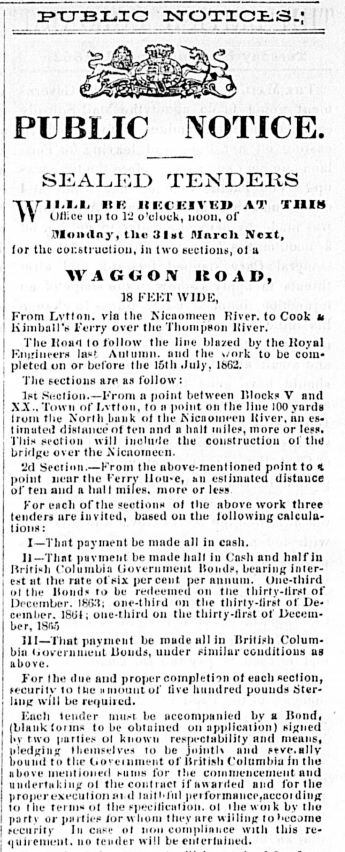
 It is interesting to read the Daily Colonist from 150 years ago. The paper has a lot of coverage of what is happening in interior of BC during the gold rush. On December 11th 1858 there is a long piece about the gold potential of the Fraser.
As you can see in the coverage from Lillooet, the first public road project went horribly over budget and took much longer than expected
Wednesday, March 28, 2012
Burns Lake Tragedy Fund created
Burns lake has gone through a horrible time with the destruction of the core of the communities industry. A Fund has been created to collect funds to help people effected by the destruction of the Babine Forest Products mill January 20th this year. The Burns Lake Tragedy Fund has now been formed as a society.
According to an article in the Burns Lake District News, the fund has $303,000 in the fund now, but they think it will get to $375,000.
Hampton, partial owner of the mill, has a website up with resources for people in the community.
According to an article in the Burns Lake District News, the fund has $303,000 in the fund now, but they think it will get to $375,000.
Hampton, partial owner of the mill, has a website up with resources for people in the community.
Wednesday, January 25, 2012
The 2011 Exploration and Mining in BC report is out - looks 2011 was a record year for exploration in BC
Each year January the BC government releases the review of mining and exploration for the previous year. The 2011 edition is out now.
Highlights:
Exploration Expenditures - (2010 figures in brackets):
In the five regions with complete data, exploration spending in 2011 was $387 million, an increase from $268 in 2010. Given all the work in the Thompson-Okanagan-Cariboo in 2011, I can not see how exploration expenditures would not be higher than 2010. If was assume the same increase as elsewhere, this would indicate $72 million for the Thompson-Okanagan-Cariboo and an annual provincewide expenditure of around $460 million.
It looks like 2011 was a record year for mineral exploration in BC, beating out the previous record of $416 million in 2007. Adjusted for inflation, the 2007 value would be $450 million.
To give you an idea how good 2011 was we can look at 1990. 1990 was a a good year for exploration in BC with $227 million spend, that is equal to $340 million in 2011 dollars.
Operating Mines in BC by year and exploration expenditures
I would go back further, but the data is not as easy for me to access. If I get it I will post.
Highlights:
Exploration Expenditures - (2010 figures in brackets):
- Omenica Region $71.5 million ($33 million)
- Skeena $220 million ($172 million)
- Northeast $41 million ($20 million)
- Thompson-Okanagan-Cariboo 2011 data incomplete($50 million)
- Coast $16 million ($15 million)
- Kootenay-Boundary $38.5 million ($28 million)
In the five regions with complete data, exploration spending in 2011 was $387 million, an increase from $268 in 2010. Given all the work in the Thompson-Okanagan-Cariboo in 2011, I can not see how exploration expenditures would not be higher than 2010. If was assume the same increase as elsewhere, this would indicate $72 million for the Thompson-Okanagan-Cariboo and an annual provincewide expenditure of around $460 million.
It looks like 2011 was a record year for mineral exploration in BC, beating out the previous record of $416 million in 2007. Adjusted for inflation, the 2007 value would be $450 million.
To give you an idea how good 2011 was we can look at 1990. 1990 was a a good year for exploration in BC with $227 million spend, that is equal to $340 million in 2011 dollars.
Operating Mines in BC by year and exploration expenditures
- Year Metal Coal Exploration $
- 2004 7 9 130
- 2005 8 9 220
- 2006 9 11 265
- 2007 11 10 416
- 2008 10 9 367
- 2009 8 9 154
- 2010 9 10 322
- 2011 10 11 460 est
I would go back further, but the data is not as easy for me to access. If I get it I will post.
Tuesday, January 24, 2012
The loss of another mill
The explosion at Babine Forest Products is horrific in the short term for the community. The death of some of the mill workers will hit the community in a way that people in urban centres can not understand, in a town of 3500 people, everyone will have known the guys that died.
People are already considering what will happen to Burns Lake now that the mill has been destroyed.
The Babine Forest Products mill had a capacity of 350 million board feet of lumber per year, this is the largest mill operated by Hampton Associates. Hampton Associates still has a smaller sawmill in Burns Lake, Decker Lake Forest Products, but this mill only has a production level of 85 million board feet per year.
Rebuilding the mill has a several issues that need to be addressed:
In theory there could be a smaller mill built in Burns Lake, but I do not see how this makes much sense for Hampton. The money needed to build a mill of the size and scale of Decker Lake is still more than a community like Burns Lake can afford.
I have no idea how the mill was insured, but there could be an insurance windfall for Hampton from the mill being destroyed.
The loss of the mill is a loss of 250 direct jobs in Burns Lake. There are about 2000 to 2200 people in the work force in the Burns Lake area. The loss of these jobs is about an 11% increase in unemployment all at once. I suspect the unemployment rate in Burns Lake is now around 20%.
To put this in terms of Victoria BC, this is as if 25,000 lost their jobs all on one day.
The impact of the loss of these jobs on the community is more than just the immediate jobs. Anyone that serviced or supplied the mill will have lost most of their work. In the next year the loss of mill worker wages in Burns Lake will amount to something around $7,000,000 - workers should get EI which means this loss will not be as big as it could have been. This may not sound like a lot, but it represents a reduction in the local economy of about 6%.
If we look at the wider economy, the unemployment rate is likely to rise to more than 30% within a few months. The economy is likely to shrink by 15% or more within the year.
Burns Lake is going to see a large out migration in the next year which means the value of houses will fall. People will not be able to pay their mortgages and will end walking away from their homes. Businesses that have bank loans are very likely to going to asked to repay them in full and from that be forced into bankruptcy.
For the Village of Burns Lake this means a loss of property taxes. But their property tax loss does not end there, the mill property is also within the village boundaries. Burns Lake's property tax rate is 6.3 times higher for industrial properties than residential properties. The impact on the loss of the mill will not be felt in 2012, but in 2013 when the assessed value of the property falls dramatically.
People are already considering what will happen to Burns Lake now that the mill has been destroyed.
The Babine Forest Products mill had a capacity of 350 million board feet of lumber per year, this is the largest mill operated by Hampton Associates. Hampton Associates still has a smaller sawmill in Burns Lake, Decker Lake Forest Products, but this mill only has a production level of 85 million board feet per year.
Rebuilding the mill has a several issues that need to be addressed:
- The cost to build a new mill - in this case one should expect to pay over $100,000,000 to build a comparable mill.
- The volume of timber needed to supply the mill. The current mill needs somewhere around 900,000 cubic meters of timber per year to operate. That is a lot of wood. To justify building the mill you would need to have at least 15-20 years of secure timber supply. I have no idea if there is the timber volume available for another mill of this size.
In theory there could be a smaller mill built in Burns Lake, but I do not see how this makes much sense for Hampton. The money needed to build a mill of the size and scale of Decker Lake is still more than a community like Burns Lake can afford.
I have no idea how the mill was insured, but there could be an insurance windfall for Hampton from the mill being destroyed.
The loss of the mill is a loss of 250 direct jobs in Burns Lake. There are about 2000 to 2200 people in the work force in the Burns Lake area. The loss of these jobs is about an 11% increase in unemployment all at once. I suspect the unemployment rate in Burns Lake is now around 20%.
To put this in terms of Victoria BC, this is as if 25,000 lost their jobs all on one day.
The impact of the loss of these jobs on the community is more than just the immediate jobs. Anyone that serviced or supplied the mill will have lost most of their work. In the next year the loss of mill worker wages in Burns Lake will amount to something around $7,000,000 - workers should get EI which means this loss will not be as big as it could have been. This may not sound like a lot, but it represents a reduction in the local economy of about 6%.
If we look at the wider economy, the unemployment rate is likely to rise to more than 30% within a few months. The economy is likely to shrink by 15% or more within the year.
Burns Lake is going to see a large out migration in the next year which means the value of houses will fall. People will not be able to pay their mortgages and will end walking away from their homes. Businesses that have bank loans are very likely to going to asked to repay them in full and from that be forced into bankruptcy.
For the Village of Burns Lake this means a loss of property taxes. But their property tax loss does not end there, the mill property is also within the village boundaries. Burns Lake's property tax rate is 6.3 times higher for industrial properties than residential properties. The impact on the loss of the mill will not be felt in 2012, but in 2013 when the assessed value of the property falls dramatically.
Monday, September 5, 2011
I can understand the fear that Stewart has of the potential of a competing port opening on the Alaska panhandle in Wrangell, but I think the resolution they have brought forward to the 2011 UBCM is not really useful for anyone.
Ultimately the fate of Northwestern BC and the Alaska Panhandle are closely connected. There are few functional connections at the moment, but if there were more the region would have more of an economic unity and protect both sides of the border form economic problems.
This is economic nationalism and personally do not think this is the sort of policy that we should engage in. Canada benefits more from trade than the US by a long shot and BC benefits more than the rest of the country. We are an economy that has been built to connect with the world.
B164 CANADA FIRST SHIPPING AND TRANSPORTATION POLICY Stewart
WHEREAS the State of Alaska is seeking access to the North American electrical grid through a connection to the Northwest Transmission line near Bob Quinn Lake, BC with an accompanying service road to the Alaska Border to service such a connection;
AND WHEREAS such a service road would enable access to Wrangell, Alaska leading to the potential development of new bulk cargo shipping facilities in Wrangell at the expense of developing and established port communities in British Columbia, denying these BC communities the economic and social benefits of increased economic activity in the northwest corridor;
AND WHEREAS the many mining and similar projects in Northwestern BC benefit from the taxation and investment policies of British Columbia and Canada:
THEREFORE BE IT RESOLVED that UBCM support a “Canada First” policy for the shipping of bulk argo and similar goods through Canadian ports rather than through Alaska and that the Province of British Columbia be encouraged to adopt and implement such a policy;
AND BE IT FURTHER RESOLVED that any connection to the Northwest Transmission line from the State of Alaska does not include the development of a service road or a new transportation corridor.
ENDORSED BY THE NORTH CENTRAL LOCAL GOVERNMENT ASSOCIATION
UBCM RESOLUTIONS COMMITTEE RECOMMENDATION: No Recommendation
UBCM RESOLUTIONS COMMITTEE COMMENTS:
The Resolutions Committee advises that the UBCM membership has not previously considered a resolution calling on the Province to adopt a “Canada First” policy for the shipping of bulk cargo and similar goods through Canadian ports rather than through Alaska; nor have members considered a resolution opposing the development of a service road or new transportation corridor related to connecting the Northwest Transmission Line to the State of Alaska.
However, the UBCM membership has endorsed a policy position supporting extensions of power infrastructure to northern and remote communities. In the 2002 Energy Policy Digest, the membership supported low-cost service extensions to provide electrical power to all areas of the province.
As well in 2004, members endorsed B25 which requested that the Minister of Energy “commit to writing a comprehensive plan for extension of the electrical grid into the northwest region that considers long-term community and resource development needs.” Then again in 2008, B45 which “urged the continuance of the proposed environmental programs and projects, with a focus on the Northwest Transmission Line, namely the Terrace to Bob Quinn portion of the 287 kV line.”
Ultimately the fate of Northwestern BC and the Alaska Panhandle are closely connected. There are few functional connections at the moment, but if there were more the region would have more of an economic unity and protect both sides of the border form economic problems.
This is economic nationalism and personally do not think this is the sort of policy that we should engage in. Canada benefits more from trade than the US by a long shot and BC benefits more than the rest of the country. We are an economy that has been built to connect with the world.
B164 CANADA FIRST SHIPPING AND TRANSPORTATION POLICY Stewart
WHEREAS the State of Alaska is seeking access to the North American electrical grid through a connection to the Northwest Transmission line near Bob Quinn Lake, BC with an accompanying service road to the Alaska Border to service such a connection;
AND WHEREAS such a service road would enable access to Wrangell, Alaska leading to the potential development of new bulk cargo shipping facilities in Wrangell at the expense of developing and established port communities in British Columbia, denying these BC communities the economic and social benefits of increased economic activity in the northwest corridor;
AND WHEREAS the many mining and similar projects in Northwestern BC benefit from the taxation and investment policies of British Columbia and Canada:
THEREFORE BE IT RESOLVED that UBCM support a “Canada First” policy for the shipping of bulk argo and similar goods through Canadian ports rather than through Alaska and that the Province of British Columbia be encouraged to adopt and implement such a policy;
AND BE IT FURTHER RESOLVED that any connection to the Northwest Transmission line from the State of Alaska does not include the development of a service road or a new transportation corridor.
ENDORSED BY THE NORTH CENTRAL LOCAL GOVERNMENT ASSOCIATION
UBCM RESOLUTIONS COMMITTEE RECOMMENDATION: No Recommendation
UBCM RESOLUTIONS COMMITTEE COMMENTS:
The Resolutions Committee advises that the UBCM membership has not previously considered a resolution calling on the Province to adopt a “Canada First” policy for the shipping of bulk cargo and similar goods through Canadian ports rather than through Alaska; nor have members considered a resolution opposing the development of a service road or new transportation corridor related to connecting the Northwest Transmission Line to the State of Alaska.
However, the UBCM membership has endorsed a policy position supporting extensions of power infrastructure to northern and remote communities. In the 2002 Energy Policy Digest, the membership supported low-cost service extensions to provide electrical power to all areas of the province.
As well in 2004, members endorsed B25 which requested that the Minister of Energy “commit to writing a comprehensive plan for extension of the electrical grid into the northwest region that considers long-term community and resource development needs.” Then again in 2008, B45 which “urged the continuance of the proposed environmental programs and projects, with a focus on the Northwest Transmission Line, namely the Terrace to Bob Quinn portion of the 287 kV line.”
Thursday, September 1, 2011
UBCM Resolution seeking better infrastructure funding for small communities
Another 2011 UBCM resolution here. I like this one in general, but I think it should be limited to rural communities without neighbouring local governments. When a single community is divided into multiple local governments, I do not think it should ever be made easy for the small jurisdictions to exist.
In the Victoria area there are 13 local governments for what is at best three different communities - maybe four if you think Sooke is clearly separate. One of them, Highlands, had no business being allowed to incorporate and does nothing to improve the region. They should be not be allowed to benefit from the public purse simply by being a low population jurisdiction.
B31 INFRASTRUCTURE FUNDING FOR SMALL COMMUNITIES Lillooet
WHEREAS small communities under 2,500 population which are dependent on residential taxation are struggling to fund infrastructure improvements;
AND WHEREAS the federal and provincial governments have not committed to providing future funding for infrastructure upgrades:
THEREFORE BE IT RESOLVED that UBCM petition the federal and provincial governments to continue to fund Towns for Tomorrow, Local Motion and federal/provincial infrastructure programs.
ENDORSED BY THE SOUTHERN INTERIOR LOCAL GOVERNMENT ASSOCIATION
UBCM RESOLUTIONS COMMITTEE RECOMMENDATION: Endorse
UBCM RESOLUTIONS COMMITTEE COMMENTS:
The Resolutions Committee notes that the UBCM membership has consistently endorsed resolutions seeking the federal and provincial governments to fund various infrastructure programs (2000-B12, 2004-A7, 2009- B129).
In the Victoria area there are 13 local governments for what is at best three different communities - maybe four if you think Sooke is clearly separate. One of them, Highlands, had no business being allowed to incorporate and does nothing to improve the region. They should be not be allowed to benefit from the public purse simply by being a low population jurisdiction.
B31 INFRASTRUCTURE FUNDING FOR SMALL COMMUNITIES Lillooet
WHEREAS small communities under 2,500 population which are dependent on residential taxation are struggling to fund infrastructure improvements;
AND WHEREAS the federal and provincial governments have not committed to providing future funding for infrastructure upgrades:
THEREFORE BE IT RESOLVED that UBCM petition the federal and provincial governments to continue to fund Towns for Tomorrow, Local Motion and federal/provincial infrastructure programs.
ENDORSED BY THE SOUTHERN INTERIOR LOCAL GOVERNMENT ASSOCIATION
UBCM RESOLUTIONS COMMITTEE RECOMMENDATION: Endorse
UBCM RESOLUTIONS COMMITTEE COMMENTS:
The Resolutions Committee notes that the UBCM membership has consistently endorsed resolutions seeking the federal and provincial governments to fund various infrastructure programs (2000-B12, 2004-A7, 2009- B129).
Wednesday, August 31, 2011
Resource Revenue Sharing with Rural Communities
These are two motions coming forward to the 2011 UBCM Convention
B29 RURAL DIVIDEND Barriere
WHEREAS the “Rural British Columbia Project Discussion Paper Series”, under an initiative called “Reversing the Tide”, has identified a number of best practices that, if put in place, would spur economic revitalization in the rural BC economy;
AND WHEREAS reinvesting a percentage of the natural resource dollars back into the regions from which they are extracted has proven to be a positive step in rural economic revitalization in other parts of the world:
THEREFORE BE IT RESOLVED that the provincial government be requested to develop a program that would provide additional financial and capacity building resources for rural BC communities, as well as create a “Rural Dividend” that would return to rural BC communities a fair share of the revenue created by rural-based resource industry activity in their respective regions.
ENDORSED BY THE SOUTHERN INTERIOR LOCAL GOVERNMENT ASSOCIATION
UBCM RESOLUTIONS COMMITTEE RECOMMENDATION: Endorse with Amendment Proposed
THEREFORE BE IT RESOLVED that the provincial government be requested to develop a program that would provide additional financial and capacity building resources to communities by returning a fair share of the revenue created by resource industry activity in their respective regions.
UBCM RESOLUTIONS COMMITTEE COMMENTS:
The Resolutions Committee notes that UBCM members have sought opportunities for new revenue sources(Financing Local Government Study 1998) and the Communities and Resources Committee recommended in its1998 policy paper that “a portion of the stumpage revenue must remain in the harvesting area (revenue should start flowing back to the producing communities).”
More recently, UBCM members have supported and requested that the Province share resource revenues with local governments (2009-B30, 2004 Resource Revenue Sharing Policy Paper, 2003-B30).
The Committee has offered an amendment to reflect the broader policy position of resource revenue sharing that has been adopted by the membership.
B30 REVENUE SHARING FROM MINING ROYALTIES Kitimat-Stikine RD
WHEREAS mineral industry activity involves non renewable resources and creates demand on local
government infrastructure and services such as community water systems, roads and emergency and protective services;
AND WHEREAS property taxation alone is often inaccessible and insufficient for affected communities
within a region to provide needed services and infrastructure:
THEREFORE BE IT RESOLVED that UBCM call upon the provincial and federal governments to
provide revenue sharing from natural resources for local governments affected by resource extractions
in their regions.
ENDORSED BY THE NORTH CENTRAL LOCAL GOVERNMENT ASSOCIATION
UBCM RESOLUTIONS COMMITTEE RECOMMENDATION: endorse
UBCM RESOLUTIONS COMMITTEE COMMENTS:
The Resolutions Committee notes that UBCM members have endorsed resolutions and policy papers that have sought a sharing of resource revenues with local governments recognizing that communities should be compensated for the natural resources that are extracted from their regions.
The Communities and Resources Committee recommended in its 1998 policy paper that “a portion of the stumpage revenue must remain in the harvesting area (revenue should start flowing back to the producing communities).”
In 2004, members endorsed the 2004 Resource Revenue Sharing Policy Paper, which specifically sought a sharing of resource revenues with local governments (forest stumpage, mining royalties) and prior to that a 2003 resolution, B30, made a similar request.
There is a huge fiscal imbalance in BC. The province collects 100% more money from rural BC than it offers in services to rural communities. The gap is about $5000 per rural resident per year. A large part of this imbalance from natural resource revenues, though not all of it.
If the majority of BC, and rural BC represents 90% of the landbase in BC, is to remain sustainable there needs to be mechanisms in place to allow rural communities to look after the myriad of issues that are currently being neglected. Rural local governments have become beggars among the primary sources of wealth in this province.
Urban BC would have to see much higher taxation if there were no resource revenues coming in. The provincial government would see $3.5 billion dollar gap in the budget, that would be a record setting deficit.
There has been some resource revenue sharing with some rural communities, specifically with the First Nations, but ultimately all rural communities should benefit. The various forestry, oil and gas, and mining agreements that have been signed in BC with the First Nations means that BC First Nations are the first ones in Canada with real own source government revenues to operate aboriginal governments. There have been some dramatic improvements in governance in rural BC First Nations over the last five years.
If these motions pass, the BC Government should take note and act on the resolutions. For Christy Clark, this would be a core way to bolster support in rural BC. The HST vote results, where rural BC voted 61.85% to scarp the HST, indicate to me there is an ongoing populist revolt in rural BC that is pissed off with government. The BC Liberals should be secure in re-election in 25-30 ridings, but those are almost all in Metro Vancouver or the Fraser Valley. The current mood in rural BC is not good for the government.
B29 RURAL DIVIDEND Barriere
WHEREAS the “Rural British Columbia Project Discussion Paper Series”, under an initiative called “Reversing the Tide”, has identified a number of best practices that, if put in place, would spur economic revitalization in the rural BC economy;
AND WHEREAS reinvesting a percentage of the natural resource dollars back into the regions from which they are extracted has proven to be a positive step in rural economic revitalization in other parts of the world:
THEREFORE BE IT RESOLVED that the provincial government be requested to develop a program that would provide additional financial and capacity building resources for rural BC communities, as well as create a “Rural Dividend” that would return to rural BC communities a fair share of the revenue created by rural-based resource industry activity in their respective regions.
ENDORSED BY THE SOUTHERN INTERIOR LOCAL GOVERNMENT ASSOCIATION
UBCM RESOLUTIONS COMMITTEE RECOMMENDATION: Endorse with Amendment Proposed
THEREFORE BE IT RESOLVED that the provincial government be requested to develop a program that would provide additional financial and capacity building resources to communities by returning a fair share of the revenue created by resource industry activity in their respective regions.
UBCM RESOLUTIONS COMMITTEE COMMENTS:
The Resolutions Committee notes that UBCM members have sought opportunities for new revenue sources(Financing Local Government Study 1998) and the Communities and Resources Committee recommended in its1998 policy paper that “a portion of the stumpage revenue must remain in the harvesting area (revenue should start flowing back to the producing communities).”
More recently, UBCM members have supported and requested that the Province share resource revenues with local governments (2009-B30, 2004 Resource Revenue Sharing Policy Paper, 2003-B30).
The Committee has offered an amendment to reflect the broader policy position of resource revenue sharing that has been adopted by the membership.
B30 REVENUE SHARING FROM MINING ROYALTIES Kitimat-Stikine RD
WHEREAS mineral industry activity involves non renewable resources and creates demand on local
government infrastructure and services such as community water systems, roads and emergency and protective services;
AND WHEREAS property taxation alone is often inaccessible and insufficient for affected communities
within a region to provide needed services and infrastructure:
THEREFORE BE IT RESOLVED that UBCM call upon the provincial and federal governments to
provide revenue sharing from natural resources for local governments affected by resource extractions
in their regions.
ENDORSED BY THE NORTH CENTRAL LOCAL GOVERNMENT ASSOCIATION
UBCM RESOLUTIONS COMMITTEE RECOMMENDATION: endorse
UBCM RESOLUTIONS COMMITTEE COMMENTS:
The Resolutions Committee notes that UBCM members have endorsed resolutions and policy papers that have sought a sharing of resource revenues with local governments recognizing that communities should be compensated for the natural resources that are extracted from their regions.
The Communities and Resources Committee recommended in its 1998 policy paper that “a portion of the stumpage revenue must remain in the harvesting area (revenue should start flowing back to the producing communities).”
In 2004, members endorsed the 2004 Resource Revenue Sharing Policy Paper, which specifically sought a sharing of resource revenues with local governments (forest stumpage, mining royalties) and prior to that a 2003 resolution, B30, made a similar request.
There is a huge fiscal imbalance in BC. The province collects 100% more money from rural BC than it offers in services to rural communities. The gap is about $5000 per rural resident per year. A large part of this imbalance from natural resource revenues, though not all of it.
If the majority of BC, and rural BC represents 90% of the landbase in BC, is to remain sustainable there needs to be mechanisms in place to allow rural communities to look after the myriad of issues that are currently being neglected. Rural local governments have become beggars among the primary sources of wealth in this province.
Urban BC would have to see much higher taxation if there were no resource revenues coming in. The provincial government would see $3.5 billion dollar gap in the budget, that would be a record setting deficit.
There has been some resource revenue sharing with some rural communities, specifically with the First Nations, but ultimately all rural communities should benefit. The various forestry, oil and gas, and mining agreements that have been signed in BC with the First Nations means that BC First Nations are the first ones in Canada with real own source government revenues to operate aboriginal governments. There have been some dramatic improvements in governance in rural BC First Nations over the last five years.
If these motions pass, the BC Government should take note and act on the resolutions. For Christy Clark, this would be a core way to bolster support in rural BC. The HST vote results, where rural BC voted 61.85% to scarp the HST, indicate to me there is an ongoing populist revolt in rural BC that is pissed off with government. The BC Liberals should be secure in re-election in 25-30 ridings, but those are almost all in Metro Vancouver or the Fraser Valley. The current mood in rural BC is not good for the government.
Subscribe to:
Posts (Atom)
