In rural BC the school districts and BC Transit could work together to provide transit.
The rural school districts have to provide a lot of bus service to get the kids to the schools. I remember in Lillooet that more than half the kids were riding buses to get to school each day. These school districts need to have qualified drivers and own the buses already.
A town like Lillooet has no public transit. If you live in Pavilion or the Fountain Valley there is no way to get to town unless someone gives you a ride. From one end of Lillooet to the other is more than six kilometers and unless you call the cab you have to walk or drive a car.
What if BC Transit worked with the school districts to make use of the existing buses and drivers to provide a basic transit service? The school districts could defray some of their expenses, BC Transit could offer a service for lot less than otherwise and a small town would have an alternative.
Routes and schedules could all be worked out, but if we work from the idea of an eight hour work day for the driver and the school schedule, you should be able to stagger some of the drivers a bit earlier in the day and some a bit later and give a transit coverage for close to ten hours of the day. I am not certain, but the fares could be enough to cover the extra costs of offering the service.
Adults riding on existing runs with the kids would be a direct cost recovery. All that would need to be done is ensure that the seats are there for the kids and only the extra ones are available to the general public.
During the day some of the buses could offer an in town and near regional service. At the end of the day possibly one extra commuter run could be an option.
It strikes me that for many of the small rural towns in BC this could be an easy way to provide a transportation option for those without cars.
Tuesday, March 12, 2013

Wednesday, September 19, 2012
Leon Creek Church
I was inspired to post these because of a piece in the Lillooet News. The article speaks of a painting of a church that they were not clear where it was, I could see right away it was the church on the Leon Creek Reserve of the Ts'kw'aylacw First Nation. Some are from a trip as part of the Treaty negotiations in 1998, the others are from a camping trip I took with my brother in August of 2000.


 |
| The church in 1998 |

 |
| August 2000 |

 |
| Fred Alec 1998 |
 |
| Interior of the church |
 |
| The wall behind the altar |
 |
| Bridge over the Little Leon Creek to get to the buildings on the reserve in 1998 |
 |
| Looking out the front door of the church in August 2000 |
 |
| Looking out of a church window |
 |
| Houses on the Leon Creek Reserve August 2000 |
 |
| Looking at the church from a house on the Leon Creek reserve |
Wednesday, September 12, 2012
Prince Rupert will start to collect property taxes from non-profits
This comes for the September 7th Northern View
By Alan S. Hale - The Northern View
Published: September 07, 2012 4:00 PM
Updated: September 07, 2012 9:19 PM
Community organizations that are used to not having to pay property taxes are going start feeling the pinch next year. The city council has decided to begin rolling back property tax exemptions by 40 percent over two years starting in 2013.
Mayor Jack Mussallem suggested the idea saying it was another way to decrease city spending in order to address public complaints about the City’s tax rates.
“By the end of [2014] we’ll still have a property tax exemption but it will only apply to 60 percent [of what they would owe without an exemption]. So each year we are creating a 20 percent allowance to ease the overall taxation in the community,” says Mussallem.
The reason for rolling it back over two years is to ease the community organizations into making up the difference with donations from the community at large.
Only the exemptions given to churches, schools and the largely city-owned properties known as the “Big Six” (civic centre, library, golf course/racquet centre, museum, Lester Centre, visitors centre, tourism board) will be spared from the rollback. While the City is prevented from taxing the church buildings because of the community charter, the rollback will affect the exemption they are given on their parking lots.
The tax exemptions that will be affected add up to being under $100,000, which means in 2013 the city well be getting $20,000 in new tax money and $40,000 the next year.
Since it was elected, this City council has been hard on Prince Rupert community organizations; it has also frozen all community enhancement grants at their current levels, and cut others. They’ve done all of this and saved very little money.
While getting $40,000 in new taxes is much more money than the $3,000 council saved by cutting some of the community enhancement grants, $40,000 still only represents a 0.2 percent increase in Prince Rupert’s property tax income.
Property tax exemptions have been a longstanding way for the City to help worthy organizations without actually spending any money.
Some of the organizations affected are important pillars of the community such as the Friendship House, which in 2014 will have to find a way to pay $7,530 that it normally doesn’t have to worry about. The North Coast Transition Society, the salmon hatchery, the senior’s centre, Moose lodge, and aboriginal justice society will all have to come up with the money as well.
Meanwhile, the City is spending $4.18-million on the 45 members of city staff that make over $75,000 a year.
I am very concerned about this because of the sort of precedence it sets. As someone that served a term as the director responsible for a lot of properties for a non-profit, if they were all assessed taxes, even some of the taxes, it would become unsustainable and much higher fees would have to be charged for the youth to enroll in the program.
I get that Prince Rupert is between a rock and a hard place, but many of the directions they are looking at are not ones that in the long term make sense. They have already expressed concern they can not raise the property taxes of the port.
Prince Rupert is also considering selling the municipal golf course to raise the funds needed to pay for the new emergency service building.
By Alan S. Hale - The Northern View
Published: September 07, 2012 4:00 PM
Updated: September 07, 2012 9:19 PM
Community organizations that are used to not having to pay property taxes are going start feeling the pinch next year. The city council has decided to begin rolling back property tax exemptions by 40 percent over two years starting in 2013.
Mayor Jack Mussallem suggested the idea saying it was another way to decrease city spending in order to address public complaints about the City’s tax rates.
“By the end of [2014] we’ll still have a property tax exemption but it will only apply to 60 percent [of what they would owe without an exemption]. So each year we are creating a 20 percent allowance to ease the overall taxation in the community,” says Mussallem.
The reason for rolling it back over two years is to ease the community organizations into making up the difference with donations from the community at large.
Only the exemptions given to churches, schools and the largely city-owned properties known as the “Big Six” (civic centre, library, golf course/racquet centre, museum, Lester Centre, visitors centre, tourism board) will be spared from the rollback. While the City is prevented from taxing the church buildings because of the community charter, the rollback will affect the exemption they are given on their parking lots.
The tax exemptions that will be affected add up to being under $100,000, which means in 2013 the city well be getting $20,000 in new tax money and $40,000 the next year.
Since it was elected, this City council has been hard on Prince Rupert community organizations; it has also frozen all community enhancement grants at their current levels, and cut others. They’ve done all of this and saved very little money.
While getting $40,000 in new taxes is much more money than the $3,000 council saved by cutting some of the community enhancement grants, $40,000 still only represents a 0.2 percent increase in Prince Rupert’s property tax income.
Property tax exemptions have been a longstanding way for the City to help worthy organizations without actually spending any money.
Some of the organizations affected are important pillars of the community such as the Friendship House, which in 2014 will have to find a way to pay $7,530 that it normally doesn’t have to worry about. The North Coast Transition Society, the salmon hatchery, the senior’s centre, Moose lodge, and aboriginal justice society will all have to come up with the money as well.
Meanwhile, the City is spending $4.18-million on the 45 members of city staff that make over $75,000 a year.
I am very concerned about this because of the sort of precedence it sets. As someone that served a term as the director responsible for a lot of properties for a non-profit, if they were all assessed taxes, even some of the taxes, it would become unsustainable and much higher fees would have to be charged for the youth to enroll in the program.
I get that Prince Rupert is between a rock and a hard place, but many of the directions they are looking at are not ones that in the long term make sense. They have already expressed concern they can not raise the property taxes of the port.
Prince Rupert is also considering selling the municipal golf course to raise the funds needed to pay for the new emergency service building.
Friday, May 11, 2012
Red Chris mine gets mine permit

Red Chris finished the BC Environmental Assessment process in 2005 and finished the Canadian one in 2006. The plan was for the mine to be operating by 2006, but this has not happened. One thing that is improving the feasibility of the project is the Northwest Transmission Line, though it ends at Bob Quinn Lake, some 115 kilometres away.
The mine is the heart of the Tahltan country and only 25 kilometres from Iskut. Dease Lake is a further 65 kilometres north of there. The Tahltan have not endorsed the project, but they have also not spoken against it. The project should mean an increase in business and population in both Dease Lake and Iskut which have a current population of about 800.
The mine has a projected life of 28 years, so if it opens in 2014 or 2015, it should operate through to about 2043.
The mine will employ about 300 people directly, these salaries alone will be worth $30,000,000 a year. It is hard to estimate how many more people will be indirectly employed because of the mine, but it will be a significant number.
The mine will produce about 85,000,000 pounds of copper per year and 95,000 ounces of gold per year. That is a gross annual income of $465,000,000 based on the prices of copper and gold today. The estimated cost to build the mine is about $443,000,000.
The opening of this one mine alone will have a noticeable impact on provincial revenues. The province should recoup the $561 million cost of the Northwest Transmission line before 2020 from increased tax revenues alone.
Tuesday, April 17, 2012
Tuesday, April 3, 2012
Monday, April 2, 2012
150 years the processing of tendering to build the road from Lytton to the Ashcroft area
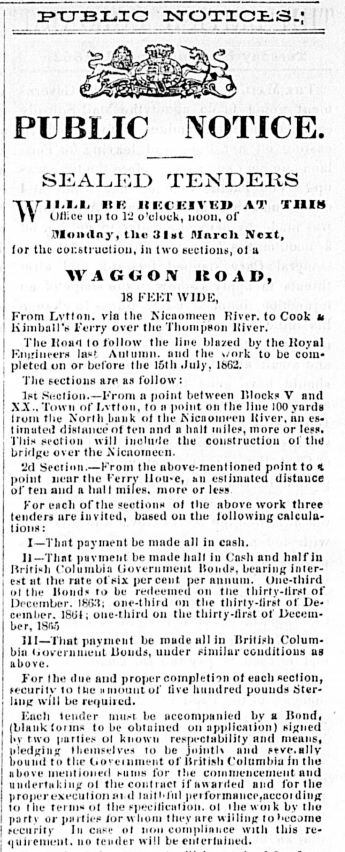
 It is interesting to read the Daily Colonist from 150 years ago. The paper has a lot of coverage of what is happening in interior of BC during the gold rush. On December 11th 1858 there is a long piece about the gold potential of the Fraser.
As you can see in the coverage from Lillooet, the first public road project went horribly over budget and took much longer than expected
Subscribe to:
Posts (Atom)
