Tuesday, April 17, 2012

Tuesday, April 3, 2012
Monday, April 2, 2012
150 years the processing of tendering to build the road from Lytton to the Ashcroft area
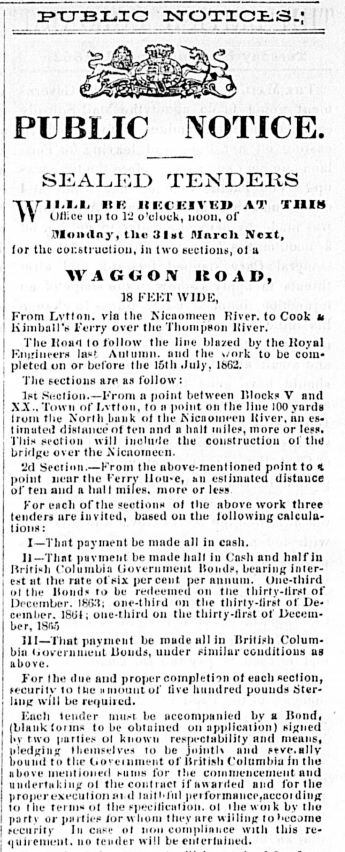
 It is interesting to read the Daily Colonist from 150 years ago. The paper has a lot of coverage of what is happening in interior of BC during the gold rush. On December 11th 1858 there is a long piece about the gold potential of the Fraser.
As you can see in the coverage from Lillooet, the first public road project went horribly over budget and took much longer than expected
Wednesday, March 28, 2012
Burns Lake Tragedy Fund created
Burns lake has gone through a horrible time with the destruction of the core of the communities industry. A Fund has been created to collect funds to help people effected by the destruction of the Babine Forest Products mill January 20th this year. The Burns Lake Tragedy Fund has now been formed as a society.
According to an article in the Burns Lake District News, the fund has $303,000 in the fund now, but they think it will get to $375,000.
Hampton, partial owner of the mill, has a website up with resources for people in the community.
According to an article in the Burns Lake District News, the fund has $303,000 in the fund now, but they think it will get to $375,000.
Hampton, partial owner of the mill, has a website up with resources for people in the community.
Wednesday, January 25, 2012
The 2011 Exploration and Mining in BC report is out - looks 2011 was a record year for exploration in BC
Each year January the BC government releases the review of mining and exploration for the previous year. The 2011 edition is out now.
Highlights:
Exploration Expenditures - (2010 figures in brackets):
In the five regions with complete data, exploration spending in 2011 was $387 million, an increase from $268 in 2010. Given all the work in the Thompson-Okanagan-Cariboo in 2011, I can not see how exploration expenditures would not be higher than 2010. If was assume the same increase as elsewhere, this would indicate $72 million for the Thompson-Okanagan-Cariboo and an annual provincewide expenditure of around $460 million.
It looks like 2011 was a record year for mineral exploration in BC, beating out the previous record of $416 million in 2007. Adjusted for inflation, the 2007 value would be $450 million.
To give you an idea how good 2011 was we can look at 1990. 1990 was a a good year for exploration in BC with $227 million spend, that is equal to $340 million in 2011 dollars.
Operating Mines in BC by year and exploration expenditures
I would go back further, but the data is not as easy for me to access. If I get it I will post.
Highlights:
Exploration Expenditures - (2010 figures in brackets):
- Omenica Region $71.5 million ($33 million)
- Skeena $220 million ($172 million)
- Northeast $41 million ($20 million)
- Thompson-Okanagan-Cariboo 2011 data incomplete($50 million)
- Coast $16 million ($15 million)
- Kootenay-Boundary $38.5 million ($28 million)
In the five regions with complete data, exploration spending in 2011 was $387 million, an increase from $268 in 2010. Given all the work in the Thompson-Okanagan-Cariboo in 2011, I can not see how exploration expenditures would not be higher than 2010. If was assume the same increase as elsewhere, this would indicate $72 million for the Thompson-Okanagan-Cariboo and an annual provincewide expenditure of around $460 million.
It looks like 2011 was a record year for mineral exploration in BC, beating out the previous record of $416 million in 2007. Adjusted for inflation, the 2007 value would be $450 million.
To give you an idea how good 2011 was we can look at 1990. 1990 was a a good year for exploration in BC with $227 million spend, that is equal to $340 million in 2011 dollars.
Operating Mines in BC by year and exploration expenditures
- Year Metal Coal Exploration $
- 2004 7 9 130
- 2005 8 9 220
- 2006 9 11 265
- 2007 11 10 416
- 2008 10 9 367
- 2009 8 9 154
- 2010 9 10 322
- 2011 10 11 460 est
I would go back further, but the data is not as easy for me to access. If I get it I will post.
Tuesday, January 24, 2012
The loss of another mill
The explosion at Babine Forest Products is horrific in the short term for the community. The death of some of the mill workers will hit the community in a way that people in urban centres can not understand, in a town of 3500 people, everyone will have known the guys that died.
People are already considering what will happen to Burns Lake now that the mill has been destroyed.
The Babine Forest Products mill had a capacity of 350 million board feet of lumber per year, this is the largest mill operated by Hampton Associates. Hampton Associates still has a smaller sawmill in Burns Lake, Decker Lake Forest Products, but this mill only has a production level of 85 million board feet per year.
Rebuilding the mill has a several issues that need to be addressed:
In theory there could be a smaller mill built in Burns Lake, but I do not see how this makes much sense for Hampton. The money needed to build a mill of the size and scale of Decker Lake is still more than a community like Burns Lake can afford.
I have no idea how the mill was insured, but there could be an insurance windfall for Hampton from the mill being destroyed.
The loss of the mill is a loss of 250 direct jobs in Burns Lake. There are about 2000 to 2200 people in the work force in the Burns Lake area. The loss of these jobs is about an 11% increase in unemployment all at once. I suspect the unemployment rate in Burns Lake is now around 20%.
To put this in terms of Victoria BC, this is as if 25,000 lost their jobs all on one day.
The impact of the loss of these jobs on the community is more than just the immediate jobs. Anyone that serviced or supplied the mill will have lost most of their work. In the next year the loss of mill worker wages in Burns Lake will amount to something around $7,000,000 - workers should get EI which means this loss will not be as big as it could have been. This may not sound like a lot, but it represents a reduction in the local economy of about 6%.
If we look at the wider economy, the unemployment rate is likely to rise to more than 30% within a few months. The economy is likely to shrink by 15% or more within the year.
Burns Lake is going to see a large out migration in the next year which means the value of houses will fall. People will not be able to pay their mortgages and will end walking away from their homes. Businesses that have bank loans are very likely to going to asked to repay them in full and from that be forced into bankruptcy.
For the Village of Burns Lake this means a loss of property taxes. But their property tax loss does not end there, the mill property is also within the village boundaries. Burns Lake's property tax rate is 6.3 times higher for industrial properties than residential properties. The impact on the loss of the mill will not be felt in 2012, but in 2013 when the assessed value of the property falls dramatically.
People are already considering what will happen to Burns Lake now that the mill has been destroyed.
The Babine Forest Products mill had a capacity of 350 million board feet of lumber per year, this is the largest mill operated by Hampton Associates. Hampton Associates still has a smaller sawmill in Burns Lake, Decker Lake Forest Products, but this mill only has a production level of 85 million board feet per year.
Rebuilding the mill has a several issues that need to be addressed:
- The cost to build a new mill - in this case one should expect to pay over $100,000,000 to build a comparable mill.
- The volume of timber needed to supply the mill. The current mill needs somewhere around 900,000 cubic meters of timber per year to operate. That is a lot of wood. To justify building the mill you would need to have at least 15-20 years of secure timber supply. I have no idea if there is the timber volume available for another mill of this size.
In theory there could be a smaller mill built in Burns Lake, but I do not see how this makes much sense for Hampton. The money needed to build a mill of the size and scale of Decker Lake is still more than a community like Burns Lake can afford.
I have no idea how the mill was insured, but there could be an insurance windfall for Hampton from the mill being destroyed.
The loss of the mill is a loss of 250 direct jobs in Burns Lake. There are about 2000 to 2200 people in the work force in the Burns Lake area. The loss of these jobs is about an 11% increase in unemployment all at once. I suspect the unemployment rate in Burns Lake is now around 20%.
To put this in terms of Victoria BC, this is as if 25,000 lost their jobs all on one day.
The impact of the loss of these jobs on the community is more than just the immediate jobs. Anyone that serviced or supplied the mill will have lost most of their work. In the next year the loss of mill worker wages in Burns Lake will amount to something around $7,000,000 - workers should get EI which means this loss will not be as big as it could have been. This may not sound like a lot, but it represents a reduction in the local economy of about 6%.
If we look at the wider economy, the unemployment rate is likely to rise to more than 30% within a few months. The economy is likely to shrink by 15% or more within the year.
Burns Lake is going to see a large out migration in the next year which means the value of houses will fall. People will not be able to pay their mortgages and will end walking away from their homes. Businesses that have bank loans are very likely to going to asked to repay them in full and from that be forced into bankruptcy.
For the Village of Burns Lake this means a loss of property taxes. But their property tax loss does not end there, the mill property is also within the village boundaries. Burns Lake's property tax rate is 6.3 times higher for industrial properties than residential properties. The impact on the loss of the mill will not be felt in 2012, but in 2013 when the assessed value of the property falls dramatically.
Monday, September 5, 2011
I can understand the fear that Stewart has of the potential of a competing port opening on the Alaska panhandle in Wrangell, but I think the resolution they have brought forward to the 2011 UBCM is not really useful for anyone.
Ultimately the fate of Northwestern BC and the Alaska Panhandle are closely connected. There are few functional connections at the moment, but if there were more the region would have more of an economic unity and protect both sides of the border form economic problems.
This is economic nationalism and personally do not think this is the sort of policy that we should engage in. Canada benefits more from trade than the US by a long shot and BC benefits more than the rest of the country. We are an economy that has been built to connect with the world.
B164 CANADA FIRST SHIPPING AND TRANSPORTATION POLICY Stewart
WHEREAS the State of Alaska is seeking access to the North American electrical grid through a connection to the Northwest Transmission line near Bob Quinn Lake, BC with an accompanying service road to the Alaska Border to service such a connection;
AND WHEREAS such a service road would enable access to Wrangell, Alaska leading to the potential development of new bulk cargo shipping facilities in Wrangell at the expense of developing and established port communities in British Columbia, denying these BC communities the economic and social benefits of increased economic activity in the northwest corridor;
AND WHEREAS the many mining and similar projects in Northwestern BC benefit from the taxation and investment policies of British Columbia and Canada:
THEREFORE BE IT RESOLVED that UBCM support a “Canada First” policy for the shipping of bulk argo and similar goods through Canadian ports rather than through Alaska and that the Province of British Columbia be encouraged to adopt and implement such a policy;
AND BE IT FURTHER RESOLVED that any connection to the Northwest Transmission line from the State of Alaska does not include the development of a service road or a new transportation corridor.
ENDORSED BY THE NORTH CENTRAL LOCAL GOVERNMENT ASSOCIATION
UBCM RESOLUTIONS COMMITTEE RECOMMENDATION: No Recommendation
UBCM RESOLUTIONS COMMITTEE COMMENTS:
The Resolutions Committee advises that the UBCM membership has not previously considered a resolution calling on the Province to adopt a “Canada First” policy for the shipping of bulk cargo and similar goods through Canadian ports rather than through Alaska; nor have members considered a resolution opposing the development of a service road or new transportation corridor related to connecting the Northwest Transmission Line to the State of Alaska.
However, the UBCM membership has endorsed a policy position supporting extensions of power infrastructure to northern and remote communities. In the 2002 Energy Policy Digest, the membership supported low-cost service extensions to provide electrical power to all areas of the province.
As well in 2004, members endorsed B25 which requested that the Minister of Energy “commit to writing a comprehensive plan for extension of the electrical grid into the northwest region that considers long-term community and resource development needs.” Then again in 2008, B45 which “urged the continuance of the proposed environmental programs and projects, with a focus on the Northwest Transmission Line, namely the Terrace to Bob Quinn portion of the 287 kV line.”
Ultimately the fate of Northwestern BC and the Alaska Panhandle are closely connected. There are few functional connections at the moment, but if there were more the region would have more of an economic unity and protect both sides of the border form economic problems.
This is economic nationalism and personally do not think this is the sort of policy that we should engage in. Canada benefits more from trade than the US by a long shot and BC benefits more than the rest of the country. We are an economy that has been built to connect with the world.
B164 CANADA FIRST SHIPPING AND TRANSPORTATION POLICY Stewart
WHEREAS the State of Alaska is seeking access to the North American electrical grid through a connection to the Northwest Transmission line near Bob Quinn Lake, BC with an accompanying service road to the Alaska Border to service such a connection;
AND WHEREAS such a service road would enable access to Wrangell, Alaska leading to the potential development of new bulk cargo shipping facilities in Wrangell at the expense of developing and established port communities in British Columbia, denying these BC communities the economic and social benefits of increased economic activity in the northwest corridor;
AND WHEREAS the many mining and similar projects in Northwestern BC benefit from the taxation and investment policies of British Columbia and Canada:
THEREFORE BE IT RESOLVED that UBCM support a “Canada First” policy for the shipping of bulk argo and similar goods through Canadian ports rather than through Alaska and that the Province of British Columbia be encouraged to adopt and implement such a policy;
AND BE IT FURTHER RESOLVED that any connection to the Northwest Transmission line from the State of Alaska does not include the development of a service road or a new transportation corridor.
ENDORSED BY THE NORTH CENTRAL LOCAL GOVERNMENT ASSOCIATION
UBCM RESOLUTIONS COMMITTEE RECOMMENDATION: No Recommendation
UBCM RESOLUTIONS COMMITTEE COMMENTS:
The Resolutions Committee advises that the UBCM membership has not previously considered a resolution calling on the Province to adopt a “Canada First” policy for the shipping of bulk cargo and similar goods through Canadian ports rather than through Alaska; nor have members considered a resolution opposing the development of a service road or new transportation corridor related to connecting the Northwest Transmission Line to the State of Alaska.
However, the UBCM membership has endorsed a policy position supporting extensions of power infrastructure to northern and remote communities. In the 2002 Energy Policy Digest, the membership supported low-cost service extensions to provide electrical power to all areas of the province.
As well in 2004, members endorsed B25 which requested that the Minister of Energy “commit to writing a comprehensive plan for extension of the electrical grid into the northwest region that considers long-term community and resource development needs.” Then again in 2008, B45 which “urged the continuance of the proposed environmental programs and projects, with a focus on the Northwest Transmission Line, namely the Terrace to Bob Quinn portion of the 287 kV line.”
Subscribe to:
Posts (Atom)
